
I dug through the 2026 STAAR RLA tests for Grades 3–8 and English I–II. Here’s what I found about question types, point values, writing, repeated TEKS, paired passages, and what it all means for 2027 STAAR prep.
Apparently, I wasn’t done digging through the 2026 released STAAR tests. 😂
Over the last few months, I’ve gone back through the released STAAR RLA tests for Grades 3–8 and English I and II looking at everything from question types and point values to constructed response, revising and editing, paired passages, and the TEKS that showed up more than once.
Some of what I found was exactly what I expected.
Some of it…wasn’t.
I’ve shared bits and pieces of this on social media, but I wanted one place where teachers (and parents!) could see the bigger picture.
So, if you’re preparing students for the Spring 2027 STAAR RLA test, here are the things that stood out to me from the 2026 released tests—and what I think is actually worth paying attention to this year.
One important note before we start: This is an analysis of the 2026 released STAAR RLA tests, not a prediction of exactly what students will see in 2027. Released tests give us useful information about how the standards are being assessed, but one year of released questions shouldn’t become our entire curriculum.
TEA provides the official released tests along with answer keys, item rationales, and the student expectations tested.
1. STAAR RLA Is Definitely Not Just Multiple Choice
Let’s start with something that’s easy to forget when we’re planning test prep.
Students aren’t just reading a passage and clicking A, B, C, or D anymore.
When I went through the 2026 released RLA tests, I found students interacting with several different question formats.
Depending on the grade, those included things like:
- Multiple choice
- Multiselect
- Text entry
- Multipart
- Short constructed response (SCR)
- Extended constructed response (ECR)
- Inline choice
- Hot text
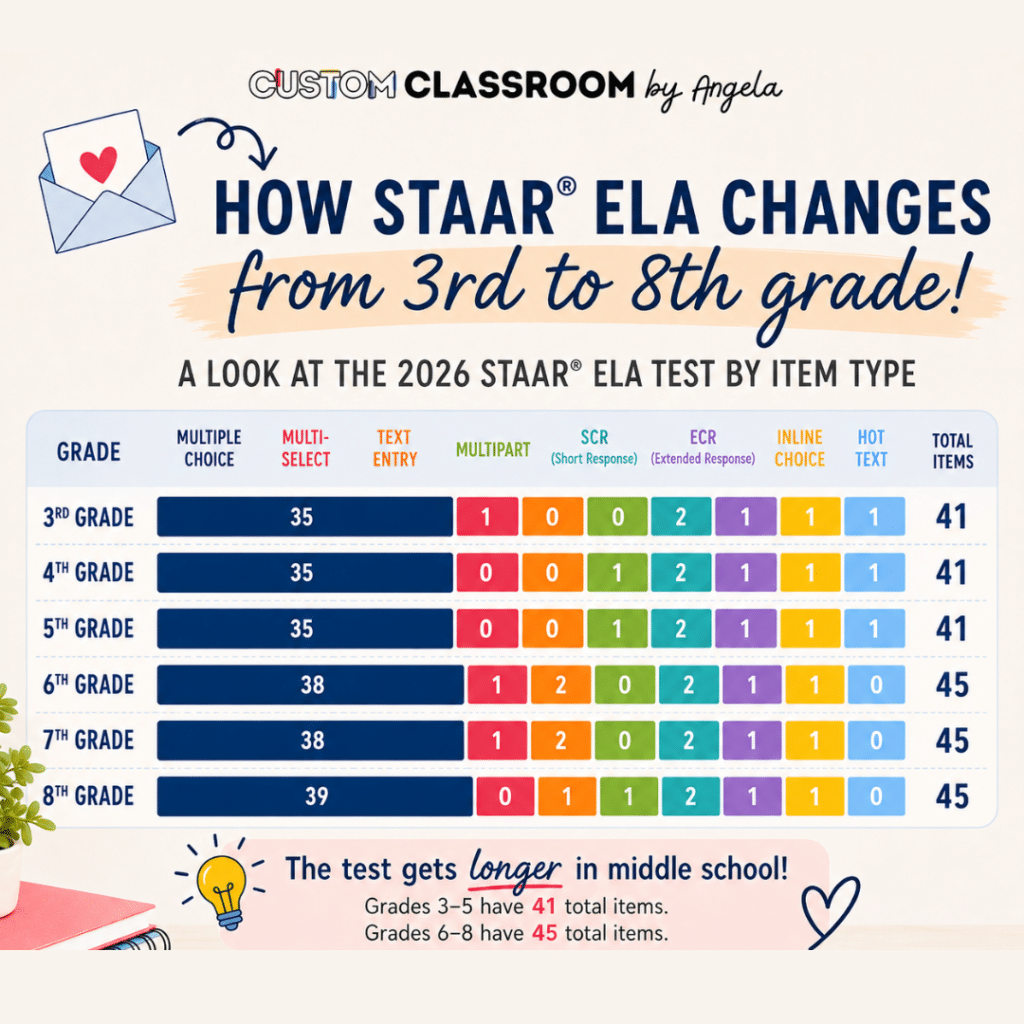
And there’s an important reason all those different formats matter.
You may have heard people talk about the “75% multiple-choice rule” for STAAR.
But there’s one little detail that gets missed all the time.
The 75% Rule Is About POINTS—Not Questions
TEA’s rule is that no more than 75% of the points on a STAAR test can come from multiple-choice questions.
It does not say that no more than 75% of the actual questions can be multiple choice.
That sounds like a tiny distinction, but it makes a pretty big difference.
When I calculated the 2026 released RLA tests, traditional multiple-choice questions made up a much larger percentage of the questions than they did of the available points.
For example, in Grades 3–5, 35 of the 41 questions were multiple choice.
That’s about 85% of the questions.
But those multiple-choice questions accounted for only about 67% of the available points.
Yep. Same test. Two very different percentages.
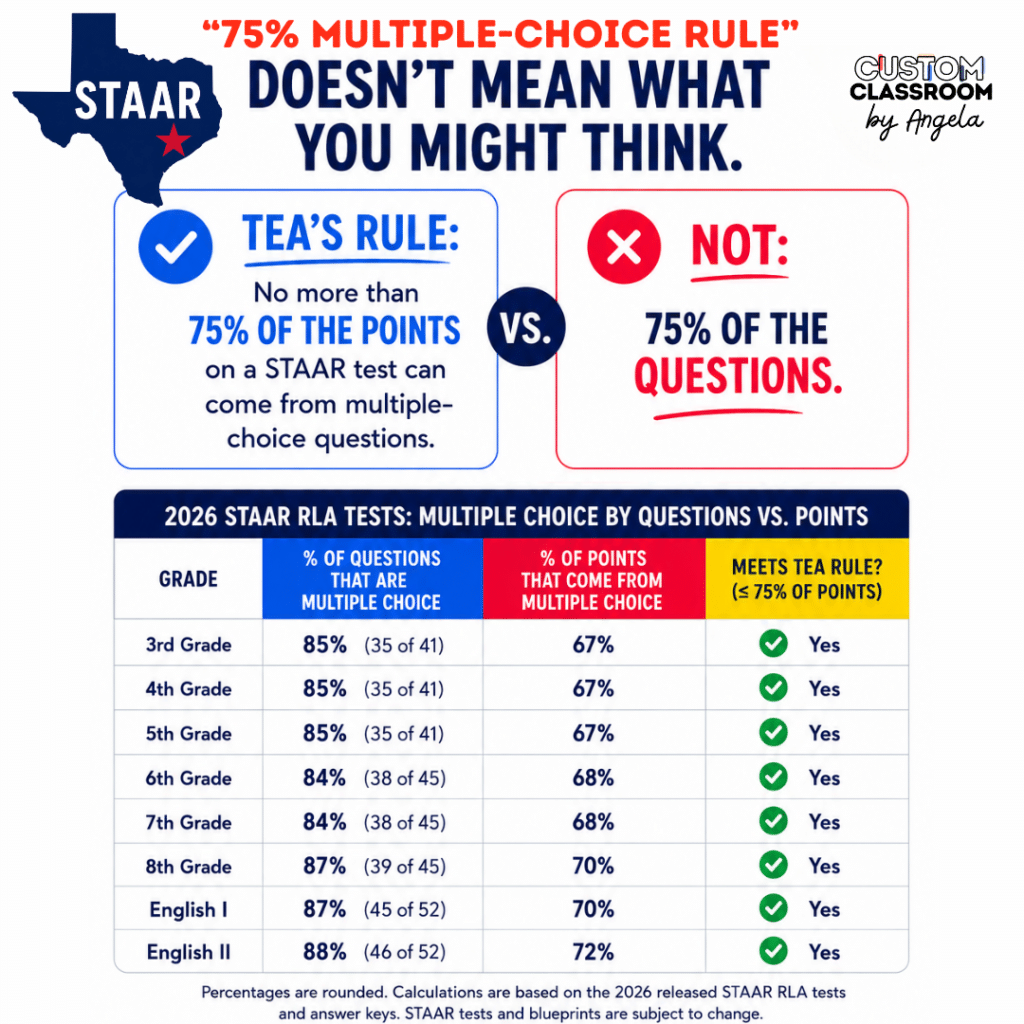
That’s because some of those other question types can contribute more than one point.
What Does That Mean for Teachers?
Students still need plenty of practice with traditional multiple-choice reading questions.
But they also need experience showing what they know in different formats.
Sometimes test prep isn’t about teaching another reading skill.
Sometimes it’s simply making sure a student doesn’t have to spend precious brainpower figuring out how the question works while also trying to figure out the answer.
Format familiarity matters.
2. Constructed Response Is Still a Big Part of STAAR RLA
This was one of the most consistent things I found when I looked across the released tests.
From 3rd grade all the way through English II, every 2026 released RLA test I analyzed included:
2 SCRs + 1 ECR

That matters because students aren’t only being asked to understand what they read.
They also have to be able to communicate that understanding in writing.
And those are two different skills.
A student may completely understand a passage and still struggle to explain that thinking clearly.
That’s why I’m a big believer in explicitly teaching students how to build a response rather than just giving them prompts and hoping they figure it out.
But when I looked beyond the number of constructed responses and started looking at the points, the ECR became even more interesting.
3. One ECR Accounts for a LOT of the Available Points
This one is especially important to understand because the scoring can be a little confusing.
On the 2026 released STAAR RLA tests, the one ECR accounts for up to 10 raw-score points.
But students aren’t actually writing a “10-point essay.”
Here’s where those 10 points come from.
The ECR itself is scored using a 5-point rubric:
Organization & Development: up to 3 points
Conventions: up to 2 points
So a student can earn a maximum rubric score of 5 points on the response. TEA currently uses a hybrid scoring process for constructed responses that includes automated scoring and human scoring/monitoring. Texas Education Agency
For the STAAR raw score, the ECR’s rubric score is then weighted so that the response contributes up to 10 raw-score points to the assessment.
In other words:
5 possible rubric points → up to 10 raw-score points on STAAR
And that’s the number that really caught my attention when I looked at the test as a whole.
That one ECR represents approximately:
- 19% of the available raw-score points in Grades 3–5
- 18% in Grades 6–8
- 16% in English I and II
One response.
That’s a pretty significant chunk of the available points.
And it’s one reason I wouldn’t wait until February or March to start worrying about extended constructed response.
Students don’t need to write perfect essays at the beginning of the year.
They need to start building the pieces.
Can they answer the question?
Can they develop a clear idea?
Can they choose relevant text evidence?
Can they explain how that evidence supports their answer?
There’s plenty of time to polish.
First, give them something worth polishing.
4. Here’s the Part That REALLY Caught My Attention: Where Do the Points Come From?
Apparently, I still wasn’t done with the spreadsheets. 😂
This time, I wanted to know what percentage of the available points was actually coming from the different parts of the RLA test.
So I sorted the 2026 released-test points into four categories:
Reading Comprehension
ECR
Revising
Editing
For this analysis, I categorized questions according to what they were assessing.
That means a short constructed response assessing a reading TEKS stays under Reading Comprehension. I’m not calling every typed response “writing” simply because a student has to type an answer.
And when I calculated the grade-band averages, this is what happened:
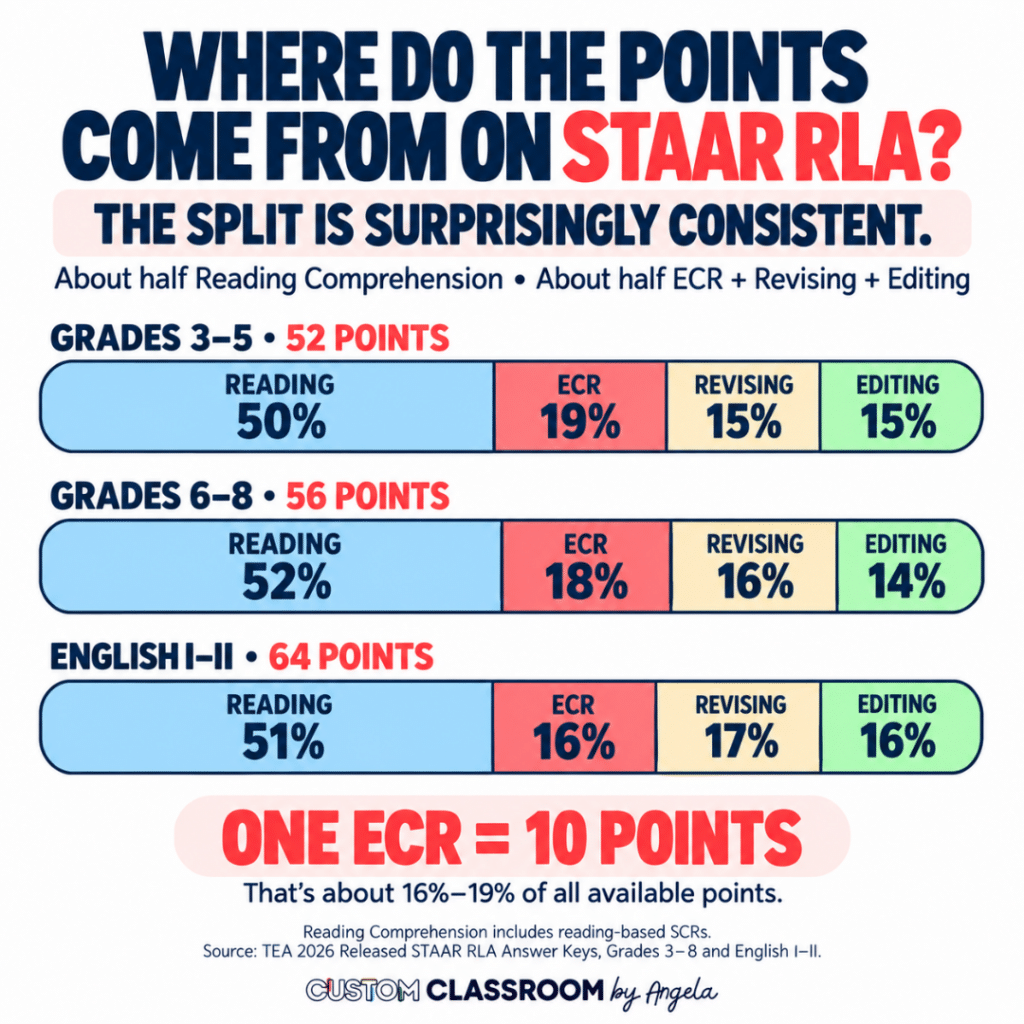
Look at how consistent that is.
Across elementary, middle school, and high school, about half of the available raw-score points came from the reading-comprehension portion.
The other roughly half came from the ECR + revising + editing.
And elementary was especially clean.
Grades 3–5 Were Exactly 50/50
Every released Grade 3–5 test had:
26 Reading Comprehension points
and
26 ECR + Revising + Editing points
That’s 52 total available raw-score points—split exactly in half.
Middle school and high school landed remarkably close to that same overall pattern.
Now, I want to be really careful about what we do with that information.
I would not say:
“Half of STAAR isn’t reading.”
That isn’t accurate.
The ECR itself requires students to read, understand, use text evidence, and write about what they’ve read. Reading and writing are very connected on the RLA assessment.
But I would say this:
If your STAAR prep focuses almost entirely on reading-comprehension questions, you’re leaving a pretty big piece of the assessment out.
Students need reading comprehension.
They need constructed-response writing.
They need revising.
And they need editing.
The 2026 numbers make that pretty hard to ignore.
5. Some Reading Skills Actually Showed Up More Than Once
Next, I wanted to look beyond question types and points and dig into the reading TEKS themselves.
So I went back through the reading questions and looked for skills that were assessed more than once on the same released test.
And yep.
There were definitely some repeat offenders. 😂

Across the grade levels, I found repeated assessment of skills involving things like:
- Author’s Purpose & Message
- Author’s Use of Language
- Paraphrasing & Summarizing
- Text Evidence
- Rhetorical Devices
- Evaluating Details to Determine Key Ideas
- Author’s Use of Text Structure
But one pattern especially caught my attention.
Author’s Purpose & Message Kept Showing Up
On the 2026 released tests, Author’s Purpose & Message appeared twice at four different grade levels:
3rd Grade — 2 questions
7th Grade — 2 questions
8th Grade — 2 questions
English I — 2 questions
That’s 4 grade levels and 8 questions tied to that broad skill area.

Author’s Use of Language was another one that caught my attention.
It appeared twice on the released tests for:
3rd Grade
5th Grade
6th Grade
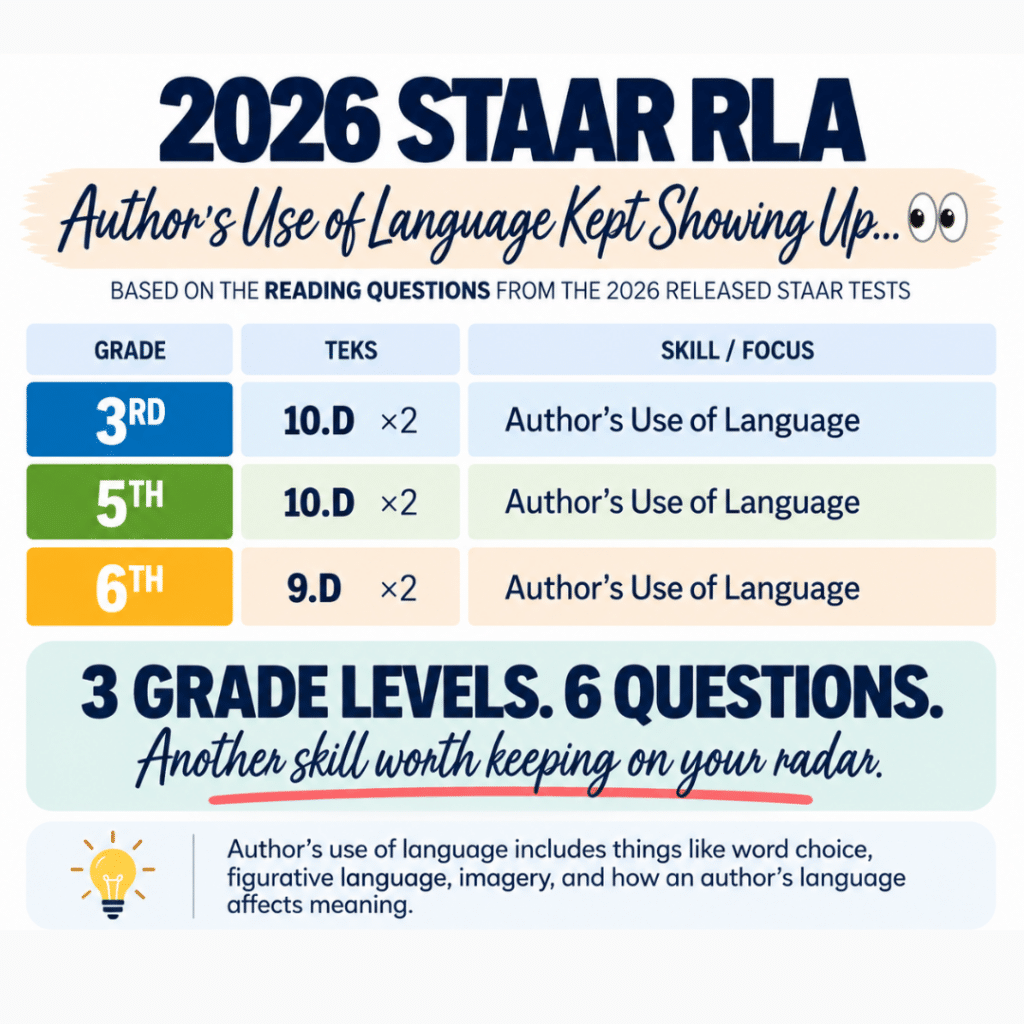
So…should we throw out our curriculum and spend the rest of the year teaching Author’s Purpose?
Nope. 😂
That is not what this data tells us.
These are released questions from one year. The same TEKS are not guaranteed to appear the same number of times on the next assessment.
But I do think released-test data gives us a useful window into the types of thinking students are being asked to do.
And when I see a broad comprehension skill appearing repeatedly across multiple grade levels, it’s something I want to keep on my radar.
6. Paired Passages Weren’t All the Same Either
Then I looked at the paired passages.
Because apparently I had committed to this rabbit hole by this point. 😂
And this was another good reminder not to make our test practice too predictable.
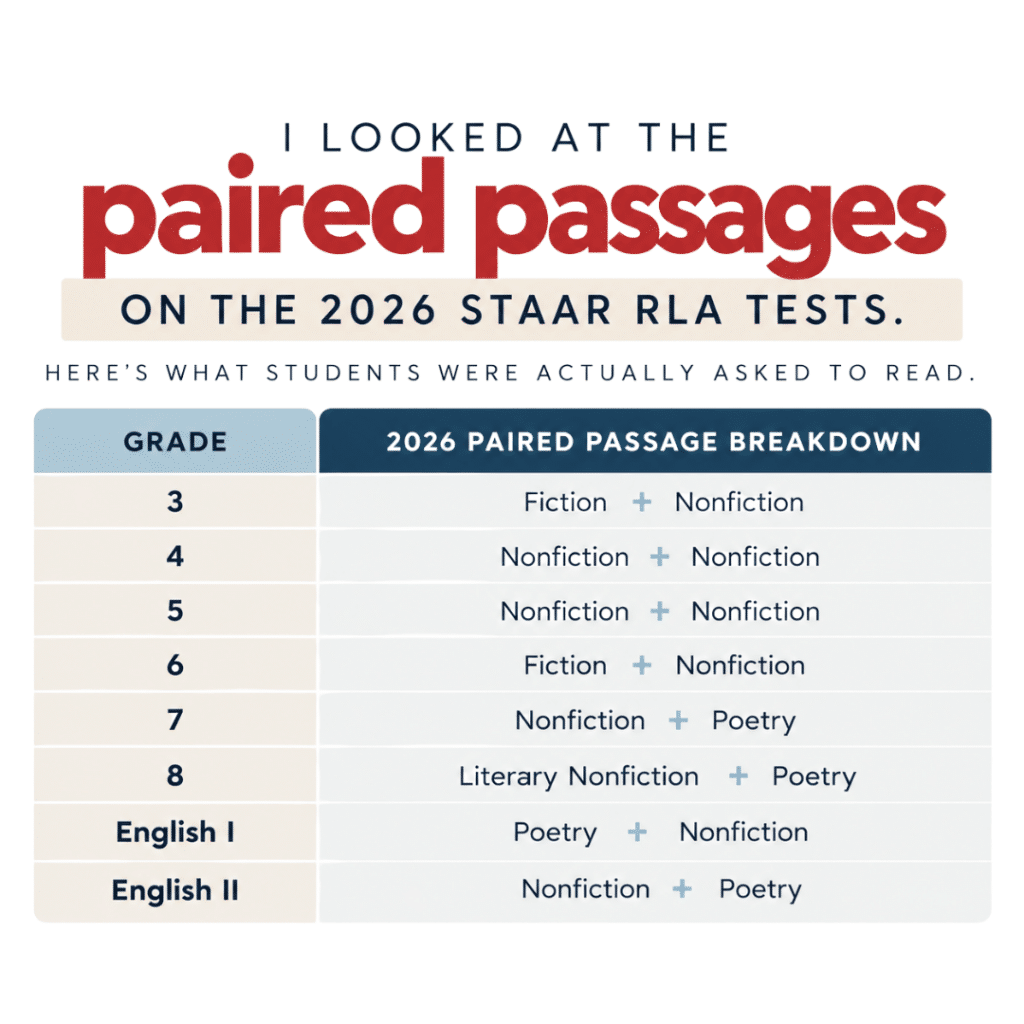
The 2026 released tests didn’t all use the same genre combination for paired passages.
I found combinations including:
Fiction + Nonfiction
Nonfiction + Nonfiction
Nonfiction + Poetry
Literary Nonfiction + Poetry
Poetry + Nonfiction
Again, I wouldn’t look at those combinations and try to predict exactly what students are going to get next spring.
That’s not the point.
The takeaway for me is much simpler:
Students need practice moving between different kinds of texts.
They should be comfortable reading two texts, thinking about how they connect, and comparing ideas, information, author choices, or other elements without expecting every paired set to look exactly the same.
So…What Do We Actually DO With All of This?
This is always my question after I dig through STAAR data.
Because random facts about a test aren’t particularly helpful if they don’t change anything we do with students.
And after looking at all of this together, I think the 2026 released tests reinforce something pretty simple:
Don’t let one part of STAAR prep crowd out everything else.
Keep Building Reading Comprehension
Of course reading matters.
Students need lots of opportunities to read different genres, answer questions, use text evidence, make inferences, analyze author’s choices, summarize, and apply the TEKS in different contexts.
But we also don’t want students practicing the exact same format over and over until they become good at that worksheet instead of becoming stronger readers.
Teach Constructed Response Explicitly
Don’t assume students automatically know how to turn good thinking into a strong written response.
They need to be taught how to answer the question, organize their thinking, choose evidence, and explain it.
And they need enough repetition for that process to become familiar.
Don’t Forget Revising and Editing
This may be the piece that stood out to me most once I looked at the point breakdown.
Revising and editing aren’t tiny add-ons at the end of STAAR RLA.
Together, they represent a meaningful portion of the available points.
Students need regular practice with them too.
Give Students Experience With Different Question Formats
I don’t want the hardest part of a STAAR question to be figuring out what they’re supposed to do with it.
Click one answer?
Select two?
Type something?
Choose from a drop-down?
Respond in writing?
The more familiar those formats feel, the more students can focus their energy on the actual reading and thinking.
And Use Released-Test Data Without Teaching to One Released Test
This is probably the biggest disclaimer I can give you.
I would never look at the 2026 released test and decide:
“Well, Author’s Purpose showed up twice, so that’s what we’re teaching!”
That’s not how this works.
Released tests give us evidence—not a crystal ball.
They can show us how TEKS have been assessed, what kinds of questions students encountered, how different portions of the assessment contribute to the score, and where students may need more familiarity.
Then we take that information and use it to make better instructional decisions.
That’s very different from trying to predict the next test.
Want to Dig Through the 2026 Released STAAR Tests Yourself?
If you enjoy spending your evening clicking through answer keys and counting questions…welcome to my weird little hobby. 😂
TEA provides the released STAAR tests along with answer keys, item rationales, and student expectations tested.
VIEW THE OFFICIAL TEA RELEASED STAAR TESTS
Or you can let me keep digging through them and I’ll share the things that actually seem worth knowing.
Need More STAAR RLA Practice?
If you’re working on these skills with students now, I have STAAR-style resources that cover reading comprehension, constructed response, revising, and editing so students can get consistent practice across the different parts of the assessment.
BROWSE MY STAAR RLA RESOURCES FOR TEACHERS
And if you’re a parent looking for structured reading and writing practice at home, I have resources designed specifically for home use too.
BROWSE READING + WRITING WORKBOOKS FOR HOME
But Wait…Isn’t STAAR Going Away?
Yep. Eventually. 😂
But not yet.
Students testing in Spring 2027 are still taking STAAR, so understanding the current STAAR RLA assessment absolutely still matters for the students we’re teaching right now.
Beginning with the 2027–28 school year, Texas transitions Grades 3–8 to the new SST assessment system.
I’ve been digging through that information too—because apparently one assessment rabbit hole wasn’t enough for me.
There are some important changes coming, but there are also things teachers are doing now that will absolutely continue to matter.
If you’re trying to figure out what STAAR going away actually means, start here:
IS STAAR GOING AWAY? WHAT IS REPLACING STAAR IN TEXAS?
For now, though?
We’ve still got one more STAAR.
And I’ll keep digging through the information so you don’t have to.
