Updated September 2026
If you’ve heard that STAAR is going away in Texas, the short answer is:
Yes…but not really.
STAAR as we know it is going away, but Texas statewide testing isn’t. Beginning in the 2027–28 school year, Texas is transitioning to a new assessment system called the Student Success Tool, or SST.
And while there are some important changes, SST isn’t a complete start-from-scratch replacement. Students will still be tested on the TEKS, so the skills teachers are already teaching still matter. What’s changing is primarily how and when those skills are assessed, not the need for students to learn them.
So if you’ve heard everything from “STAAR is completely gone!” to “Now kids have to take three STAAR tests!”—yeah…there’s a lot more to that story.
I’ve been digging through the information coming from the Texas Education Agency, so let’s break down what we actually know in plain English.
When is STAAR going away?
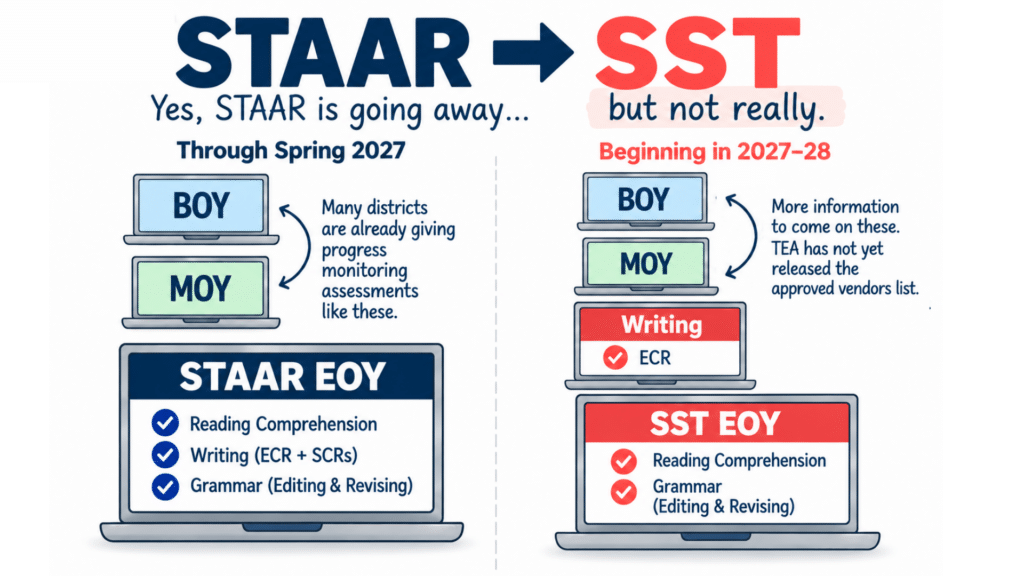
For most Texas students, STAAR is still the test for the 2026–27 school year.
For students in grades 3–8, the final STAAR administration will be Spring 2027. The new SST system begins during the 2027–28 school year.
So the simplest timeline is:
2026–27 school year → STAAR
2027–28 school year → SST begins
There is one important high-school wrinkle: STAAR EOC testing still appears on the December 2027 testing calendar for eligible students taking the remaining EOC subjects, so the EOC transition doesn’t fit quite as neatly into that timeline.
For teachers, this means something pretty important:
Don’t stop preparing students for STAAR yet.
Students testing during the 2026–27 school year still need to be ready for the assessment they’re actually taking.
What is replacing STAAR in Texas?
The new assessment program is called the Student Success Tool (SST).
For grades 3–8, SST will include:
BOY — Beginning of Year
MOY — Middle of Year
EOY — End of Year
BOY and MOY will be adaptive, meaning the assessment can adjust based on the student’s demonstrated mastery.
The EOY assessment will be linear, more like the statewide end-of-year assessment teachers are accustomed to.
And all three assessments are designed around the grade-level TEKS.
Wait…does this mean Texas students are taking three tests now?
Technically, there are three SST assessment points. But there’s some important context here.
BOY and MOY are designed to serve as progress-monitoring assessments, while EOY serves as the statewide end-of-year assessment.
And beginning- and middle-of-year progress monitoring isn’t exactly a new concept in Texas schools.
Many districts are already giving students BOY and MOY progress-monitoring assessments.
What’s changing is that progress monitoring becomes part of the new statewide assessment system.
There’s another important piece here, too.
Districts will be allowed to use a commissioner-approved alternative assessment for BOY and MOY rather than TEA’s SST BOY and MOY assessments.
As of September 2026, TEA has not yet released the final list of approved alternatives. TEA has said that list is expected in October 2026.
So when you hear “Texas kids are going to have to take three state tests now,” there’s a little more to the story than that.
And honestly, this deserves its own explanation.
→ Coming next: Why Are Texas Students Taking 3 SST Tests? BOY, MOY & EOY Explained
Is SST just STAAR with a new name?
Hmm… 🤷♀️ Ask me again in a year.
There are definitely real changes coming with SST.
BOY and MOY will become part of the statewide assessment system for grades 3–8. Those assessments will be adaptive. Testing time is being reduced. Results will come back faster. And there are changes to RLA, writing, and the high-school EOC system.
But when I look specifically at RLA, I also don’t think we’re looking at some completely unrecognizable new test.
Many districts already give students some type of beginning- and middle-of-year progress-monitoring assessment. Under SST, Texas is essentially bringing BOY and MOY progress monitoring into the statewide system—although districts will be allowed to use commissioner-approved alternatives for those two assessments.
And then there’s the end-of-year test.
Based on the SST information and finalized blueprints TEA has released so far, a lot of it looks pretty familiar.
Students are still being assessed on the TEKS.
The item types are largely familiar.
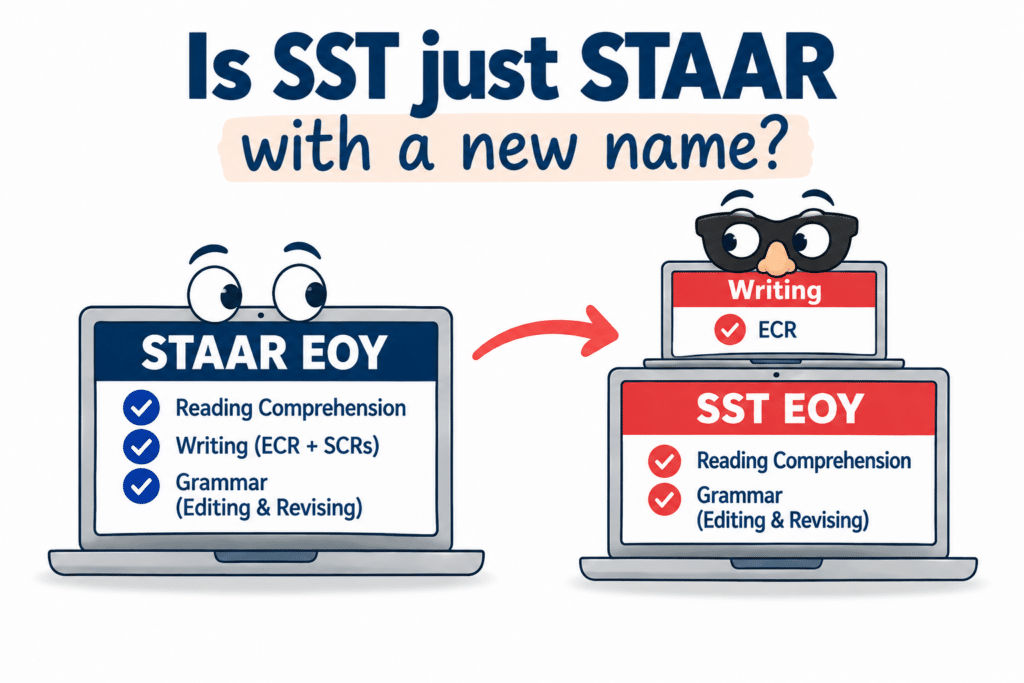
There’s still reading comprehension.
There’s still editing and revising.
There’s still an extended constructed response.
The big structural difference for RLA is that Texas is pulling the writing/open-ended portion out and administering it separately in April, while the remainder of the RLA end-of-year assessment happens later.
And overall, the SST assessment is getting shorter.
So…is SST a completely new assessment system?
Officially, yes.
Does the RLA test we’ve seen so far make me feel like teachers are going to be starting from scratch?
Not really.
Maybe in a year I’ll eat those words. 😂 We still don’t have every implementation detail, and TEA will continue releasing information as we get closer to 2027–28.
But right now, my reaction is basically:
New name. New structure. Some meaningful changes…and a whole lot that still looks pretty familiar.
Will SST still test the TEKS?
Yes.
This is probably one of the most important things for teachers and parents to understand about the transition.
SST is still being built around the Texas Essential Knowledge and Skills (TEKS).
A new assessment system does not mean Texas suddenly has a completely new set of academic skills students need to learn.
Students will still need to comprehend grade-level texts, analyze what they read, use text evidence, understand vocabulary, write effectively, revise and edit, and master their grade-level TEKS.
There are changes within the SST assessed curriculum and assessment design that teachers should understand.
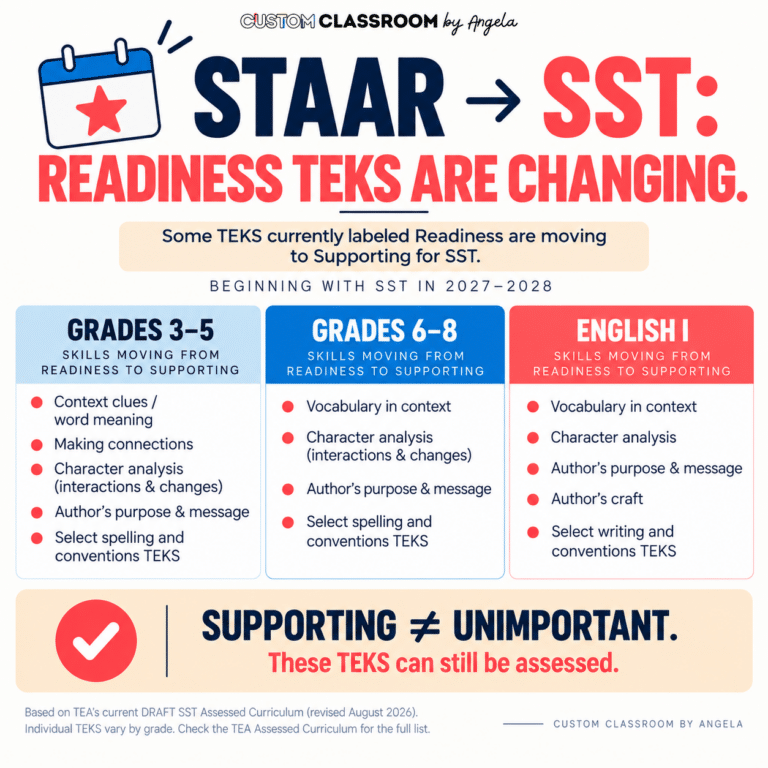
As the test gets shorter, some TEKS that are currently classified as Readiness are moving to Supporting, which can change how heavily certain skills are represented on the assessment.
But Supporting does not mean unimportant—or that teachers stop teaching those skills.
The TEKS are still the TEKS, and students still need instruction across their grade-level standards.
So while teachers will want to understand which skills may receive more or less emphasis on SST, the reading, writing, vocabulary, and language skills you’ve been teaching are still relevant.
You don’t need to throw out years of good instruction just because the assessment is changing.
So…do I need to throw away all of my STAAR resources?
If you’re currently staring at a Google Drive full of STAAR resources thinking, Well, great. What am I supposed to do with all of this now? 😂
Please don’t start deleting things.
This part is my personal take based on what TEA has released so far—not an official TEA statement.
For RLA, if a resource is teaching and practicing the TEKS, I’m keeping it.
And honestly, when I look at the STAAR resources I’ve created over the years, a LOT of what we’re already doing still fits.
Students will still need to read and comprehend texts. They’ll still analyze author’s purpose, make inferences, use text evidence, understand vocabulary, revise and edit, and work across their grade-level TEKS.
Even the test-practice piece isn’t disappearing.
Based on the SST materials TEA has released so far, students will still encounter familiar question formats such as multiple choice, multiselect, multipart, and inline choice, along with an extended constructed response (ECR).
One notable difference is the short constructed response (SCR).
Current SST RLA blueprints don’t show a separate SCR item type, while current STAAR does include SCRs.
That means SCR-specific test prep may not be necessary for SST in the same way.
But am I suddenly going to stop asking students to explain their thinking in writing because there isn’t an SCR box on the state test?
Nope. 😂
Being able to answer a question, support it with text evidence, and explain your thinking is still a pretty darn useful reading-comprehension skill—even if that exact response format isn’t on SST.
So, at least based on everything TEA has released right now, I’m not looking at my STAAR RLA resources and thinking, Welp, those are useless.
I’m looking at them and asking:
What still works exactly as it is? What needs a small SST update? And what actually needs to change?
And I’ll keep sharing what I find as I work through that process.
One more very important reminder before we get too far ahead of ourselves:
Your students are still taking STAAR this school year.
So please don’t throw out the STAAR prep just yet. 😉
What about high-school STAAR tests?
High school is a little different, and honestly, it deserves its own explanation.
Beginning with the 2027–28 school year, the remaining EOC subjects will be:
Algebra I, English I, Biology, and U.S. History.
BOY and MOY assessments are optional for those EOC subjects.
The other major change is English II.
TEA has clarified that the final English II EOC administration will be June 2027.
Students enrolled in English II during the 2026–27 school year will still take the English II EOC as first-time testers in Spring 2027.
There are some additional details involving graduation requirements and students who still need to retest, so I’m going to give high school its own explanation rather than turning this beginner’s guide into a novel.
→ Coming soon: What Happens to STAAR EOCs Under SST?
What should teachers do right now?
Honestly?
Keep doing what you’re doing—while starting to learn what’s coming next.
Your students are still taking STAAR this school year, so current STAAR preparation still matters.
At the same time, keep focusing on the things that will matter regardless of which acronym is printed at the top of the test.
Teach the TEKS.
Build strong readers and writers.
Give students experience with different question formats.
Teach them to support their thinking with evidence.
Keep building vocabulary, comprehension, writing, grammar, revising, and editing skills.
You do not need to rebuild your entire classroom overnight.
I’m actually going through my own resources with the same questions:
What still works? What needs a small update? What truly needs to change for SST?
And I’m not changing things just to put a new acronym on the cover.
If you’re looking for skill-based RLA and test-prep practice for your classroom, you can browse my Texas resources here:
What should parents do right now?
Probably nothing dramatically different.
The best preparation for either STAAR or SST is still helping your child become a stronger reader, writer, and thinker.
And remember, if your child is in grades 3–8 during the 2026–27 school year, STAAR is still the test they’re preparing to take this spring.
If you’d like some structured practice at home, I have reading, writing, grammar, and complete ELA workbooks designed to give students manageable practice with these skills and question formats.
The goal isn’t endless test prep.
It’s helping kids practice the skills they need in a way that feels manageable and familiar.
So, is STAAR really going away?
Yes.
Beginning with the 2027–28 school year, Texas is replacing STAAR with SST.
But the bigger picture is a little more nuanced than “STAAR is gone.”
Texas isn’t eliminating statewide testing. It’s moving to a different assessment structure with BOY, MOY, and EOY assessments, adaptive progress monitoring during BOY and MOY, shorter testing, faster results, and some important changes to RLA and the EOC system.
And teachers aren’t starting over.
The TEKS still matter. The skills still matter. Good instruction still matters.
We also have more than a year before students take the first SST end-of-year assessment in Spring 2028.
There’s time to figure this out.
I’ll keep digging through the TEA documents, blueprints, updates, and fine print as they’re released—so hopefully you don’t have to spend your planning period doing it. 😉
Want to keep learning about SST?
I’m building out a series of plain-English SST guides as Texas gets closer to the transition.
Coming next:
→ Why Are Texas Students Taking 3 SST Tests? BOY, MOY & EOY Explained
→ STAAR vs. SST: What’s Actually Changing?
→ SST RLA & Writing: What’s Changing?
→ Does SST Still Test the TEKS?
→ What Happens to STAAR EOCs Under SST?
For the latest official information directly from TEA: