
TEA has released updated assessed curriculum information for the new Student Success Tool (SST), which will replace STAAR beginning in the 2027–28 school year.
*Updated September 2026
And one of the changes that immediately caught my attention?
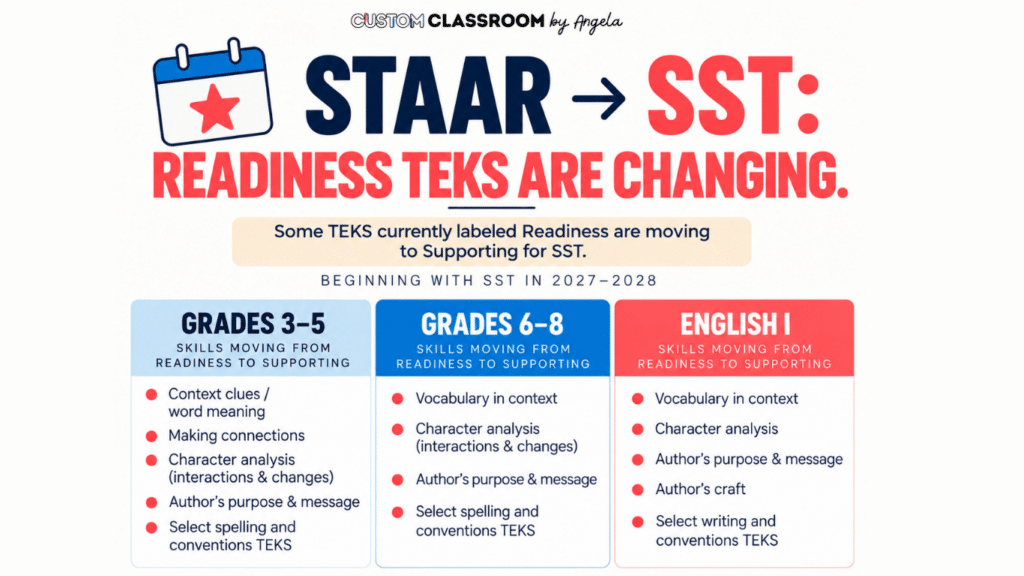
Several RLA TEKS that are currently classified as Readiness standards are moving to Supporting standards.
Before anyone starts crossing skills off the lesson plans, though… 😂
Let’s talk about what that actually means.
First: What is changing with SST?
Beginning in the 2027–28 school year, Texas will move from STAAR to the new Student Success Tool.
For grades 3–8, SST will include beginning-of-year (BOY), middle-of-year (MOY), and end-of-year (EOY) assessments. TEA has also released assessed curriculum information showing which TEKS are designated as Readiness and Supporting standards for SST.
You can see all of TEA’s current SST information and select the Assessed Curriculum document for your grade here:
TEA House Bill 8 / Student Success Tool Resources
And yes — there are some interesting changes.
Readiness vs. Supporting: What’s the difference?
This is probably the MOST important thing to understand before looking at the new lists.
A move from Readiness → Supporting does not mean that TEKS disappears from the test.
Think of it this way:
READINESS STANDARDS
These are the standards designated for annual assessment.
SUPPORTING STANDARDS
These are still part of the assessed curriculum and can still be tested, but a particular Supporting standard does not have to appear every year.
That’s a pretty important distinction.
Supporting does NOT mean optional.
Supporting does NOT mean unimportant.
Supporting does NOT mean stop teaching it.
It changes how the standard is represented in the assessment system — not whether our students need to learn the skill.
So… which RLA TEKS are changing?
This is where things get interesting.
Across the new SST assessed curriculum documents, several familiar RLA skills move from Readiness to Supporting, including expectations connected to:
- vocabulary and context
- making connections
- character analysis
- author’s purpose and message
- author’s craft/language
- spelling and conventions
The exact TEKS vary by grade, so please check your individual grade-level document rather than assuming every change applies to every grade.
Find your grade’s SST Assessed Curriculum on TEA’s website
And there’s one change in particular that REALLY caught my eye.
Wait… Author’s Purpose is moving to Supporting? 👀
If you’ve been following me on Facebook or Instagram lately, you probably know why this one made me stop.
I recently went through the reading questions on the 2026 released STAAR RLA tests looking for TEKS that appeared more than once.
And guess what kept showing up?
Author’s Purpose & Message.
It appeared multiple times in the released reading questions at several grade levels.
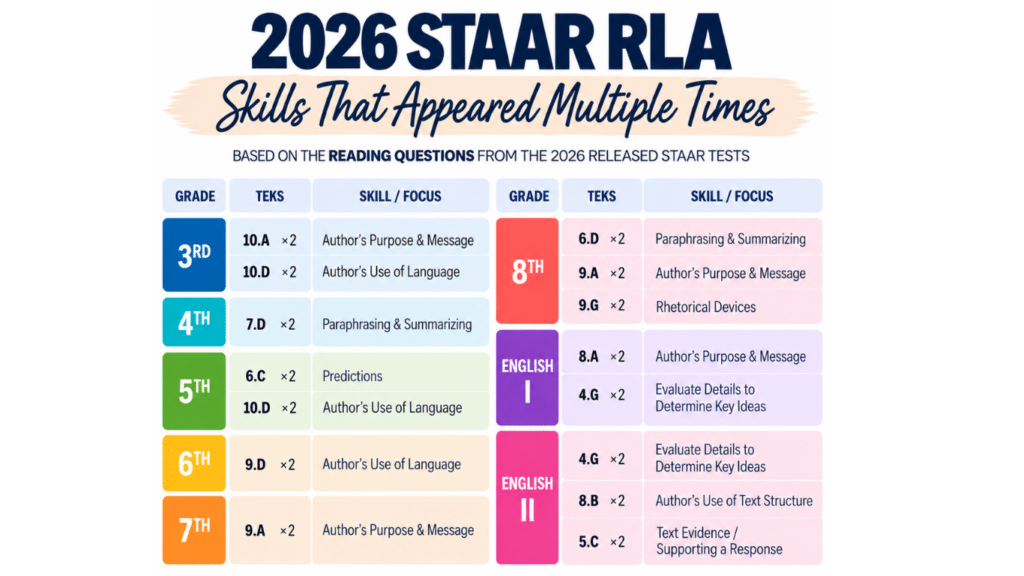
So we have a skill that was showing up repeatedly on the most recent released STAAR tests…
…and now we’re seeing Author’s Purpose expectations move from Readiness → Supporting under SST.
At first glance, that sounds like a pretty big contradiction.
It isn’t.
And I think this is actually the perfect example of why teachers need to understand what the Readiness and Supporting labels mean.
Moving Author’s Purpose to Supporting doesn’t suddenly make Author’s Purpose less important to reading comprehension.
It means we shouldn’t assume that particular TEKS expectation will be assessed every single year.
Those are two VERY different things.
My teacher take: Don’t build your curriculum around the label
This is where I’m going to get on my tiny soapbox for a minute. 😂
We still have to teach our TEKS.
Our students still need to understand author’s purpose. They still need vocabulary. They still need to analyze characters, make connections, understand an author’s language, and use evidence.
And Supporting standards can still show up on the assessment.
So I would not look at the new SST list and think:
“Great! I can spend less time teaching all of those.”
I’d look at it as another piece of information.
Knowing what’s classified as Readiness can absolutely help us understand the assessment.
But it shouldn’t become a list of “teach these / don’t teach those.”
Strong readers need all of these skills.
And the assessment can still ask them to use them.
What does this mean for STAAR this year?
Here’s another important distinction:
Nothing about this changes the STAAR test your students are taking this school year.
The SST transition begins in the 2027–28 school year. TEA says STAAR is being replaced beginning then, with BOY, MOY, and EOY SST assessments for grades 3–8.
So for right now?
Keep teaching the TEKS. Keep preparing students for the current STAAR.
We can learn about SST and start understanding what’s coming without pretending we’re already teaching in a completely different assessment system.
Honestly, that’s going to be my approach throughout this transition:
Here’s what’s on STAAR now → here’s what’s changing with SST → here’s what still matters for good reading instruction.
What should I do differently right now?
Probably less than you think.
I wouldn’t overhaul my reading instruction because a TEKS moved from Readiness to Supporting.
Instead, I’d keep doing the things that build strong readers:
✅ Teach the full curriculum.
✅ Use student data to determine where students need additional practice.
✅ Give students repeated opportunities to apply reading skills across different texts.
✅ Continue exposing students to the kinds of question formats they’ll encounter on assessments.
✅ Watch the SST changes — without throwing away everything we’re already doing well.
That’s especially important because SST isn’t abandoning the TEKS. TEA says the new assessment materials are being developed to align with the Texas Essential Knowledge and Skills.
Need targeted practice for the skills your students are struggling with?
This is actually one of the reasons I’m such a fan of skill-focused task cards.
If your data tells you students are struggling with author’s purpose, pull author’s purpose.
Text evidence? Pull text evidence.
Inference? Summarizing? Vocabulary? Figurative language?
You don’t need to stop everything and launch into full-blown test prep.
You can give students short, focused practice on the exact skill they need and keep building those skills throughout the year.
My Reading Task Card Bundles include 28 skill-focused sets, so you can pull the skill you need when you need it:
➡️ 2nd–3rd Grade Reading Task Cards
➡️ 4th–5th Grade Reading Task Cards
➡️ 6th–8th Grade Reading Task Cards
➡️ 9th–10th Grade Reading Task Cards
The goal isn’t to chase whichever TEKS we think might appear on a test.
It’s to build strong readers while being smart about the assessment our students are actually going to take.
Where can I find the SST changes myself?
You don’t have to take my word for any of this. ❤️
TEA has created a central House Bill 8 Student Assessment page where you can find the current SST resources, including the Assessed Curriculum documents for individual grades and subjects.
Go directly to TEA’s House Bill 8 / SST page
Choose your grade under Assessed Curriculum to see the current information for your students.
TEA is continuing to release SST information as Texas moves toward implementation in the 2027–28 school year, so I’ll keep digging through the updates and sharing the pieces I think actually matter for RLA teachers.
Because you have enough to do without spending your planning period digging through TEA documents. 😂


